
About

Remember those old neighborhoods that held a special place in our childhood memories? The hidden gems filled with nostalgic stories of days gone by? In this 2022 challenge, we asked participants: How can we preserve the cultural importance of such neighborhoods? How can current and future generations find relevance and connection within their streets and buildings? And finally, how can their identity be revived in a way that combines modernity with heritage?


One such beloved neighborhood that stirs a sweet nostalgic sentiment in the collective memory of its residents is Al Khobar Al Shamalia in the city of Al Khobar. During this Tanween challenge, the registration was open for local architects and designers to create a unique visual identity for this neighborhood. Under the title " AlKhobar Al Shamalia Identity Challenge", it encouraged participants to revive this historic neighborhood with creative signage and wayfinding elements. It also invited them to think beyond visuals and graphics and widen their scope to truly transform this bustling area and maintain its relevance for future generations.


This challenge was in collaboration with Wajha as the Knowledge Partner, an independent social initiative that utilizes design and branding expertise to support the community and Arab cities through providing small shops with free design services; as well as Retal, the Production Partner, who is renowned for embracing the quintessence of craftsmanship and the virtues of urbanism, reimagining properties with a holistic approach guided by a unified visionary design principle.


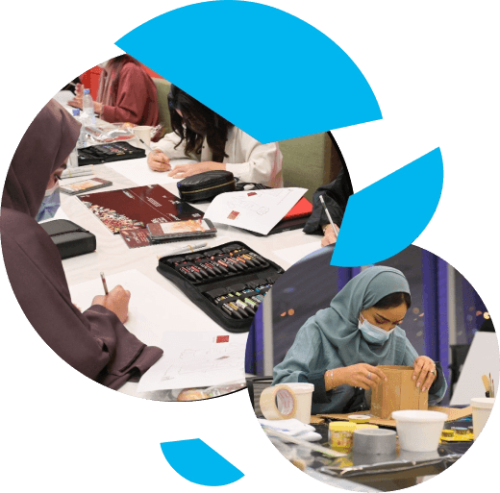
The challenge comprised several essential steps. First, the participants embarked on a research phase, enabling them to gain a deep understanding of the project's scope, social needs, and technical requirements. This groundwork laid a solid foundation for generating ideas and developing a comprehensive concept. The second step involved refining their research findings and consolidating them into a unified idea, while also establishing the project's strategy and communication tone. The third step centered around creating the project's main logo, translating the idea into a visually striking representation. In the fourth step, participants applied colors and other visual elements to produce posters, maps, and initial way-finding solutions. Lastly, participants were tasked with presenting their submissions with clarity, consistency, persuasive storytelling, and professional adherence to timing, ensuring that their work effectively conveyed their ideas.


Participants attended lectures and site visits, and examined the inherent qualities of Al Khobar Al Shamalia, noting the area’s deficiencies as well as its strengths. They identified areas of improvement that included the lack of sufficient street signage, and the absence of an emotional connection with younger generations. Among the district’s impressive attributes were its rich cultural diversity that contributes to a unique visual identity, and its grid-like street layout that promotes walkability, thus enabling residents and visitors to engage with the neighborhood and fostering a deep sense of familiarity and attachment. Ultimately, the participants aimed to foster prosperity for the area—and the city—by enhancing the area’s image, attracting visitors and investors, and encouraging projects and entrepreneurship.


The winners, Abdullah Alsaidi, Omair Albeshe, Abdulrahman Alsawas, and Mohammed Bin Turjum, demonstrated a holistic and meaningful approach in their design. Their vision was for Al Khobar Al Shamalia to become the source of new memories; whereas their mission was to create a modern environment that uplifts the lifestyle of individuals and families, fosters economic growth, and enriches cultural context. They derived the colors for their visual identity from the vibrant walls and doors of the district’s unique houses. Similarly, they incorporated abstract floral motifs inspired by the intricate designs of these doors into signage and wayfinding elements. The team also created original lettering for their Arabic and English logos, and went on to suggest designs for the neighborhood’s benches, play areas, and other elements that contribute to the user’s overall experience.


The Municipality of Al Khobar and Retal Urban Development Company played a vital role in this transformative project, as they supported the designers' vision and worked with determination and encouragement to implement it. By involving the community in the design process and allowing them to contribute to their city, this project empowered participants to become catalysts for positive change, not only in the physical appearance of the district but also in the social fabric and well-being of the community they call home.

For better web experience, please use the website in portrait mode