Download our App


Directions to Ithra
We are Closed Today
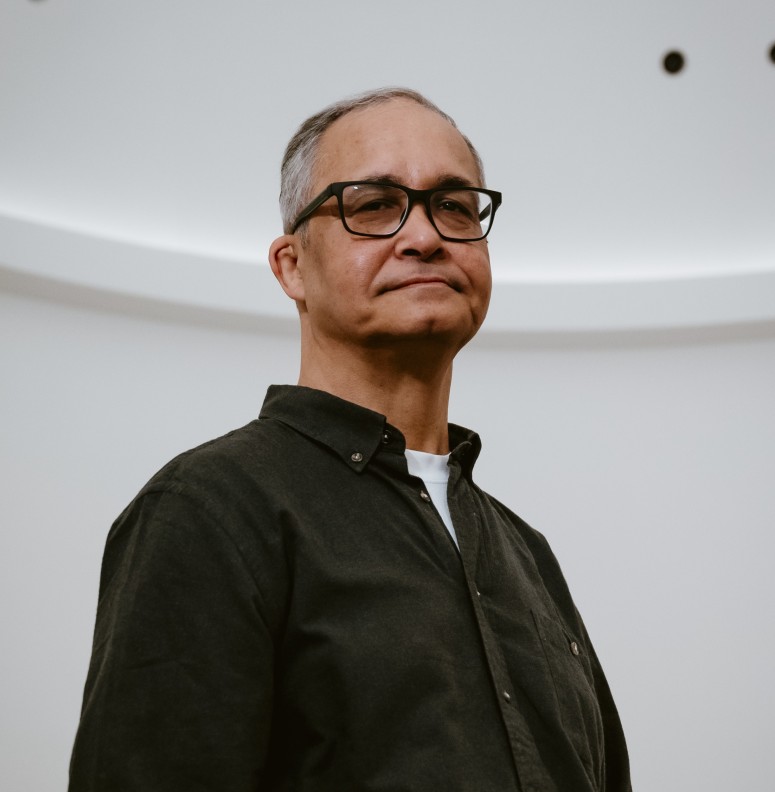
Jawad Al Malhi
Jawad Al Malhi (b. 1969, East Jerusalem, Palestine; lives and works in East Jerusalem and Abu Dhabi, UAE) works in painting, sculpture, photography, video and installation. His work focuses on the studies of the everyday lives of communities. His most recent paintings are based on close observation of the dynamics of crowds and figures in public spaces. He presented his most recent solo exhibition, Wa Ba3den, at Lumiar Cité, Lisbon (2025).
Selected group exhibitions include Thinking Historically in the Present at Sharjah Biennial 15, curated by Hoor al Qasimi (2023); The Worldly House, Documenta 13, Kassel (2012); Palestine c/o Venice, a collateral event at the Biennale Arte 2009, curated by Salwa Mikdadi (2009); and Global(e) Resistance, Centre Pompidou, Paris, curated by Christine Macel (2020). He has been artist-in-residence at Delfina Foundation, Maumaus Ecole Lisbon, IASPIS Stockholm, the Accented Residency at Townhouse Gallery, Cairo, and the Cultural Foundation, Abu Dhabi. His works are held in private and public collections in Europe and the Middle East, including the British Museum, Imperial War Museum, Centre Pompidou, Kamel Lazzar Foundation, the Barjeel Art Foundation, Guggenheim Abu Dhabi, and Sharjah Art Foundation.
Project Name: Ashes of Absence, 2026
Medium: Mixed media on canvas
Project Brief:
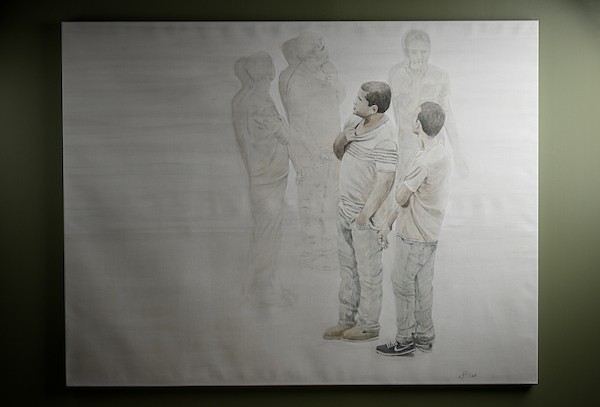
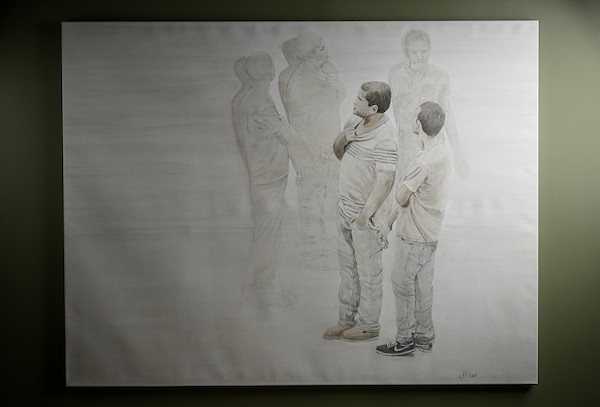
Ashes of Absence explores questions of frailty and how we are perpetually haunted by those we have lost. The figures in the paintings are rendered in tones of grey, inhabiting and pausing in nondescript places. The figures appear as former shells of themselves: fragile, an outline, a void, as though a wind passes through them. They appear colorless, while the shadow and the body no longer correspond – all is out of joint. Single, individual figures are haunted by the loss of many, their solitude marked by their inward gestures. Figures leave ghostly traces of themselves upon the space of the canvas, through shadows and layers of erased marks and lines. On the canvases, figures disappear, disintegrating and buried in the surface of the painting, while also appearing suspended in time. In this stillness, silence subsumes the air.