Download our App


Directions to Ithra
We are Closed Today
Heba Y. Amin Elmahamly
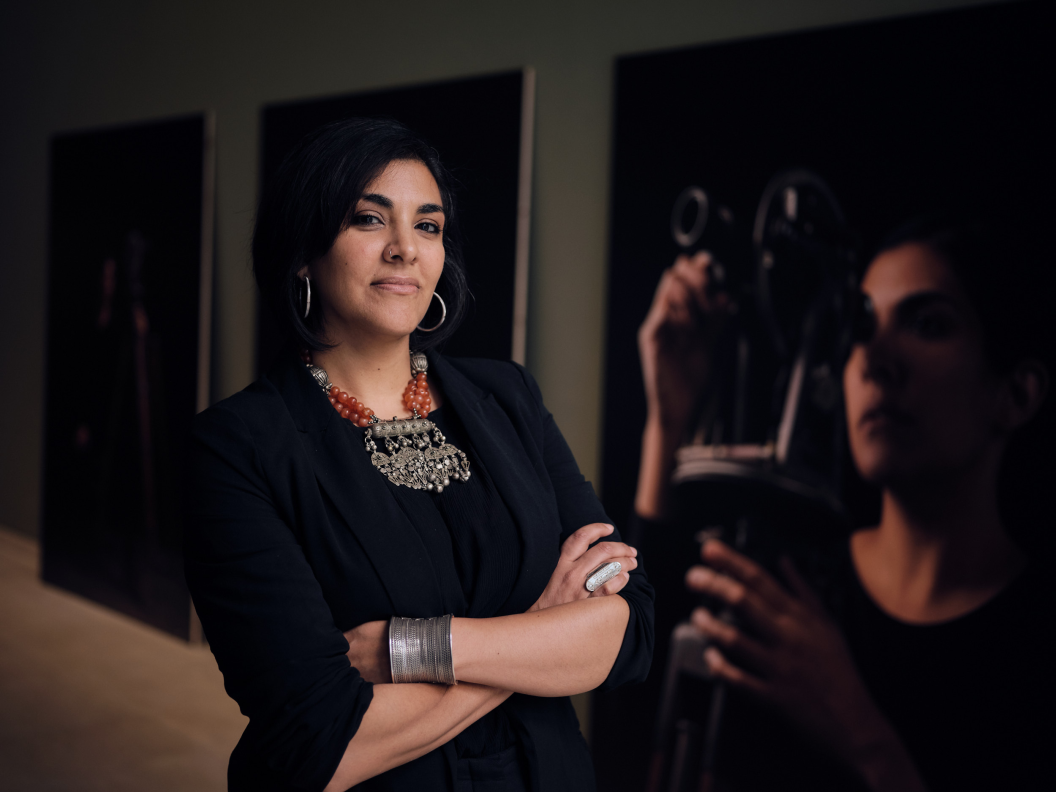
Heba Y. Amin Elmahamly, (b. 1980, Cairo),
engages with political themes and archival
history through a multidisciplinary practice that
spans film, photography, performance, and
installation. Her work critically investigates the
technologies and infrastructures of control that
shape modernity, taking as its point of departure the colonial and postcolonial histories embedded in visual and territorial regimes.
Amin Elmahamly is a Professor of Digital and
Time-Based art at the State Academy of Fine Arts in Stuttgart, curator of visual art for MIZNA
journal, co-founder of Black Athena Collective.
She was awarded the 2025 Hans-Molfenter
Preis/City of Stuttgart Prize (Germany), 2022
Nordhorn City art prize (Germany), the 2020
Sussmann Artist Award (Austria), and the 2019
Field of Vision Fellowship (NYC). Her work has
been shown in numerous exhibitions and
biennales worldwide.
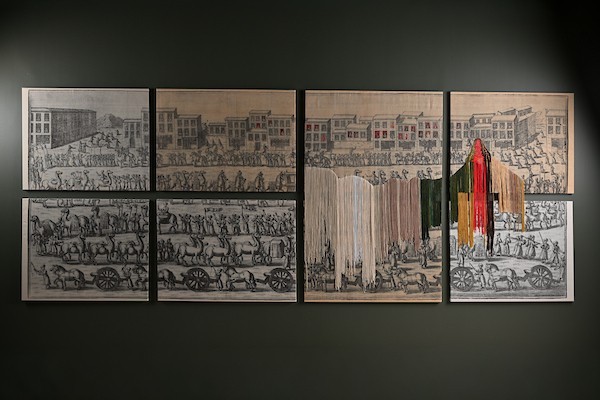
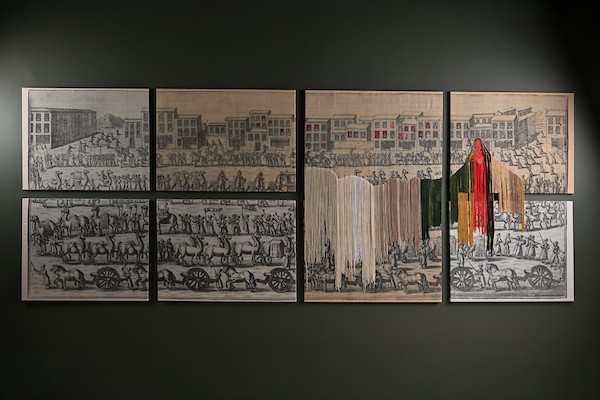
The Last Carrier: Iteration I, 2026
Medium: Screen-print, embroidery and textile
fragments on cotton/linen textile
Project Brief:
In 1719, French traveler Paul Lucas published one of the earliest European depictions of the Egyptian Mahmal procession departing from Cairo for Makkah. His limited view of the departure became a stand-in for the whole, an engraving onto which fantasy, authority, and curiosity about the “exotic East” converged.
The Last Carrier examines how vision itself shapes history: who is permitted to witness, who is excluded, and how partial sight becomes authoritative knowledge. In this sense, the engraving visualizes not the event but the desire to see—the European gaze performing itself. The project approaches the historical document as an apparatus of vision and asks how seeing, as a colonial ritual of possession, might be reimagined.
Muhammad Ahmad Elmahamly was among the last leaders of the final Mahmal caravans in the early twentieth century. As his descendent, the artist inherited his name – Elmahamly, “the carrier of the Mahmal” – and with it the responsibility to reflect on what it means to carry a legacy once visually expropriated and stripped of meaning through representation. By translating the engraving into fragmented textile panels, the work transforms the image into a site of re-vision where those once rendered as spectacle become agents who look back. What happens when those once reduced to image become the authors of vision?