Download our App


Directions to Ithra
We are Closed Today
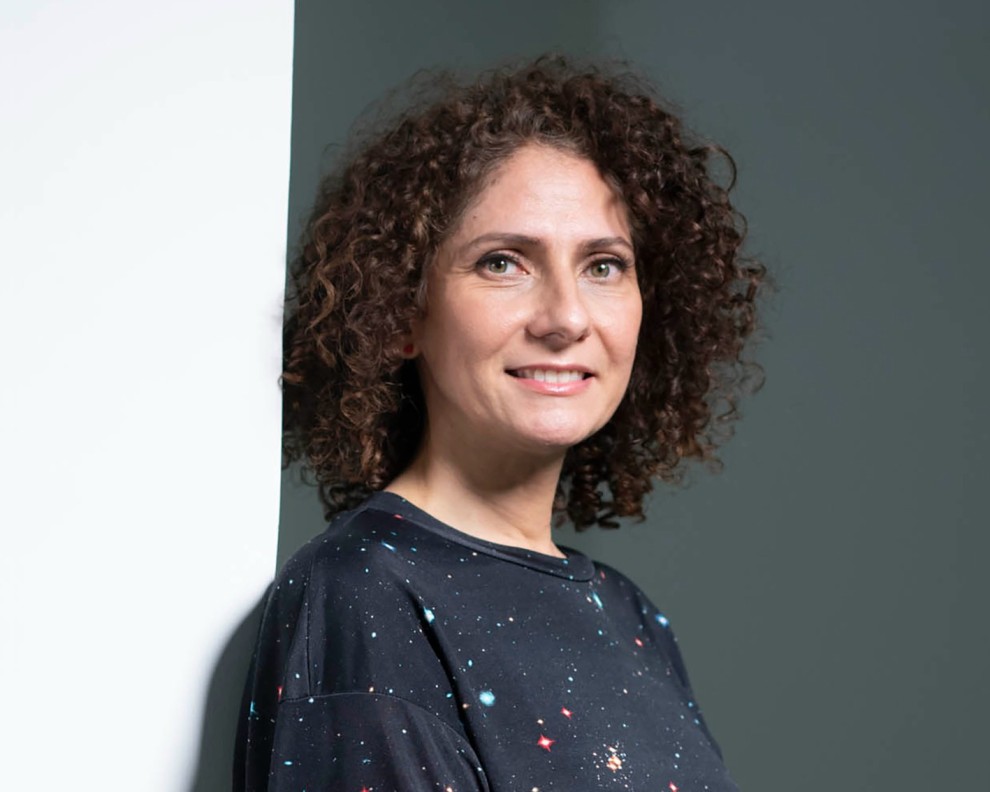
Ala Younis
Ala Younis (b. 1974, Kuwait City; lives and works in Amman, Jordan) is an artist whose practice spans research, film, curating, and publishing. Her work moves across archives, architecture, and visual culture to examine how historical narratives are constructed and how built environments shape social and political life.
Her work has been presented in solo exhibitions across the Middle East, Europe, and North America, and in major biennials including Venice, Istanbul, Gwangju, Sharjah, the Islamic Arts Biennale in Jiddah, and the Diriyah Contemporary Art Biennale. She co-founded Kayfa ta, an independent publishing initiative, in 2012, and Malaeb, a collective examining the politics of playground spaces, in 2021.
Her curatorial roles include Kuwait's national pavilion at the Venice Biennale (2013), co-Head of Berlinale's Forum Expanded (2021–2024), and co-Artistic Director of Singapore Biennale 2022. She holds a BSc in Architecture from the University of Jordan, an MRes in Visual Cultures from Goldsmiths, and is currently pursuing a DPhil in Fine Art at University of Oxford.
Project Name: Lifted Arches, 2026
Medium: 3D-printed PLA (polylactic acid), light; with companion vitrine of drawings, archival prints, and wooden studies
Size: Arch: 170 x 130 x 7 cm; vitrine dimensions variable
Project Brief:
Lifted Arches begins with a building: the Dhahran Civil Air Terminal, completed by Minoru Yamasaki in 1961, where pointed arches modulated light across façade and ceiling, embedding a modernist vocabulary deeply resonating with Islamic architectural tradition. That motif traveled through Yamasaki's subsequent work and across the Arabian Gulf, accumulating meaning with each reappearance, including when its impressions traveled on banknotes and in the memories of the people who passed through the terminal.
This sculpture compresses that lineage into a single semi-translucent form taken from a perspectival shot of its interconnected walls and ceilings. Its leaning posture is inspired by archival footage of the terminal's enormous façade panels lying flat on the ground before being lifted into place, a feat of construction that the sculpture holds in its inclination as both memory and homage. Illuminated by a light source that moves slowly to mimic the arc of the sun, the arch casts shifting shadows across the surrounding walls, suggesting multiple presences from a single object, architecture felt before it is built. The sculpture's position within the exhibition space is oriented in relation to this movement, so that light and shadow behave as they would under natural conditions.
Produced during regional conflict that repeatedly interrupted its making, the work holds that context within its material logic. The immaterial carries what the material alone cannot; glimpsed further through a companion vitrine of drawings, archival images, and process objects tracing the formal and conceptual evolution of the piece, and the personal histories this structure continues to evoke.